
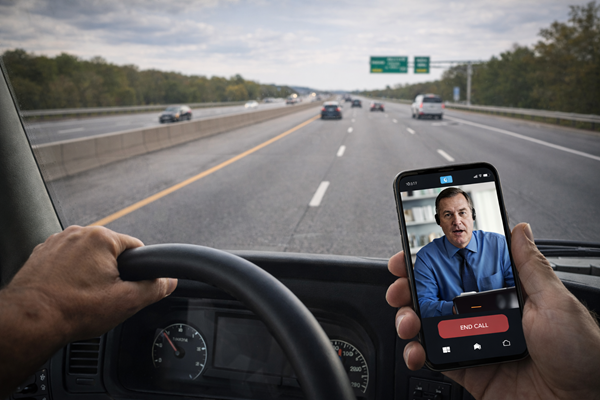
The Teams Call That Threatened Highway 402
Imagine travelling down Highway 402 on a clear afternoon with your family when a fully loaded tractor-trailer suddenly drifts into your lane without warning. The sheer mass of a commercial vehicle bears down on passenger cars like an avalanche, leaving little room for evasive action and almost no margin for error.
That could have been a reality, had it not been for the OPP stopping a distracted trucker just outside of London, Ontario. According to authorities, the driver was actively participating in a Microsoft Teams video meeting while barrelling down the busy highway. The driver was immediately charged under the Highway Traffic Act for having a display screen visible while operating the heavy vehicle.
The Ontario truck accident lawyers at Smitiuch Injury Law see the terrifying aftermath of these completely preventable collisions. When a professional driver takes their eyes off the road for even a few seconds to check a phone or adjust a navigation system, they’re making a conscious choice that severely threatens public safety. A single moment of distraction behind the wheel of a massive transport truck inevitably sets off a violent chain reaction that frequently ends in catastrophic injury or wrongful death.
Why Commercial Distraction is a Systemic Failure
The reality of modern freight transportation means drivers face immense pressure to meet tight delivery windows while managing constant communication from their dispatchers. This high-stress environment breeds dangerous habits inside the cab, where the physical demands of controlling a heavy vehicle clash directly with the digital demands of modern logistics. A distracted truck driving collision doesn’t just happen randomly, but rather it occurs because multiple corporate safety protocols fail simultaneously.
- Mobile Device Usage: Checking text messages or entering coordinates into an unauthorized mobile GPS app pulls a driver's visual and cognitive focus completely away from the highway ahead.
- In-Cab Technology Adjustments: Interacting with complicated electronic logging devices or dispatch tablets while the truck is in motion forces drivers to take their hands off the steering wheel.
- Eating and Drinking: Consuming full meals behind the wheel requires significant physical coordination, severely delaying a driver's ability to react to sudden traffic slowdowns.
- Fatigue and Cognitive Drift: Severe exhaustion combined with monotonous stretches of highway creates a mental fog in which the driver looks ahead but fails to process the surrounding traffic hazards.
The Physics of an Avalanche Collision
Understanding the mechanical reality of commercial transport is important when evaluating why these specific crashes cause such extreme devastation for victims. A standard passenger vehicle might weigh around 1,800 kilograms, while a fully loaded commercial transport truck can easily exceed 36,000 kilograms on Ontario highways.
The basic physics of momentum dictate that forcing such massive weight to a complete stop requires significant time and hundreds of metres of clear braking distance. Data from the Ministry of Transportation Ontario clearly demonstrates that commercial vehicles need substantially more room to stop safely than standard passenger cars.
When a truck driver looks down at a phone for just five seconds while travelling at 100 kilometres per hour, their rig covers the length of a football field completely blind. By the time the distracted driver looks back up and finally registers the stopped traffic ahead, the required braking distance has already vanished. The resulting impact forces the heavy truck up and over the smaller passenger vehicles, crushing protective frames and causing severe blunt force trauma to the occupants inside.
The immense physical force generated by a speeding transport truck simply overwhelms the safety features of a standard family car.
A Real World Look At Inattentive Driving
It helps to look at exactly how a routine trip can instantly become a tragedy through a series of poor decisions inside the cab.
For example, imagine a truck driver hauling heavy steel coils along the QEW who decides to reach across the passenger seat to grab a dropped water bottle. In the three seconds it takes to secure the bottle, the highway begins to curve slightly, but the driver's steering input remains completely straight. The massive vehicle drifts across the painted lane markers and sideswipes a minivan, which causes the smaller vehicle to spin violently into the concrete median barrier.
Strict Penalties Under the Highway Traffic Act
Ontario has some of the toughest distracted driving laws in North America for a reason. Under the Highway Traffic Act, fully licensed drivers caught with a display screen visible face:
- First Offence: Fines up to $1,000, three demerit points, and a mandatory three-day license suspension.
- Professional Consequences: These infractions are recorded on the employer’s Commercial Vehicle Operator's Registration (CVOR), threatening the company’s ability to stay in business.
At Smitiuch Injury Law, we use these regulatory violations as the foundation for our lawsuits, proving that the driver and the trucking company ignored clear provincial safety mandates.
Prevention Strategies And Fleet Accountability
Trucking companies hold a profound legal and moral responsibility to monitor their fleets and ensure their drivers maintain strict focus while operating heavy machinery. Corporate logistics managers can’t simply hand over the keys and turn a blind eye to the dangerous habits their tight delivery schedules might inadvertently encourage. Fleet operators who fail to implement basic safety technologies and robust training protocols share the blame when their drivers inevitably cause devastating highway collisions.
- Driver Facing Cameras: Installing dual-facing dashcams allows safety managers to review in-cab footage and quickly identify drivers who regularly text or eat while driving.
- Collision Mitigation Systems: Modern radar systems can detect sudden slowdowns in traffic and automatically apply the heavy truck's brakes before a distracted driver even reacts.
- Strict Scheduling Protocols: Dispatchers must build sufficient time into delivery routes so drivers never feel forced to multitask or skip mandatory rest periods at highway service centres.
- Zero Tolerance Policies: Companies need to establish and strictly enforce firm rules that mandate immediate termination for any commercial driver caught using a handheld device behind the wheel.
Holding Logistics Corporations Accountable
Victims of distracted truck driving collisions face an incredibly difficult road to physical and financial recovery long after the wreckage is finally cleared from the highway. Surviving a violent impact with a commercial tractor-trailer frequently results in traumatic brain injuries, shattered limbs, and permanent spinal cord damage that requires lifelong medical care.
Insurance companies representing these massive freight corporations will immediately deploy aggressive defense teams to downplay the driver's distraction and reduce the financial compensation they owe to injured families. This is exactly why you need an Ontario truck accident lawyer to uncover the truth about what happened inside the cab and fight to hold negligent truck drivers accountable.
If you were injured because a commercial truck driver failed to keep their eyes on the road, you don’t have to fight the corporate insurance companies alone. Smitiuch Injury Law has the resources and legal knowledge to investigate the crash and help you fight for the compensation you deserve. Contact us today to schedule a free consultation and learn how we can protect your rights.
“Mike and his entire team took excellent care of us in a troubling time. They responded to our questions in short order, which took away so much stress and uncertainty. They let us have a say in the way our case was going. We always felt that they had our best interests in mind. They treated us like family. Thank you!!!” ⭐⭐⭐⭐⭐
